
Years after the first dyadic trial, and with new research now validating its principles, the author returns to demonstrate the model once more.
Mindset & Identity
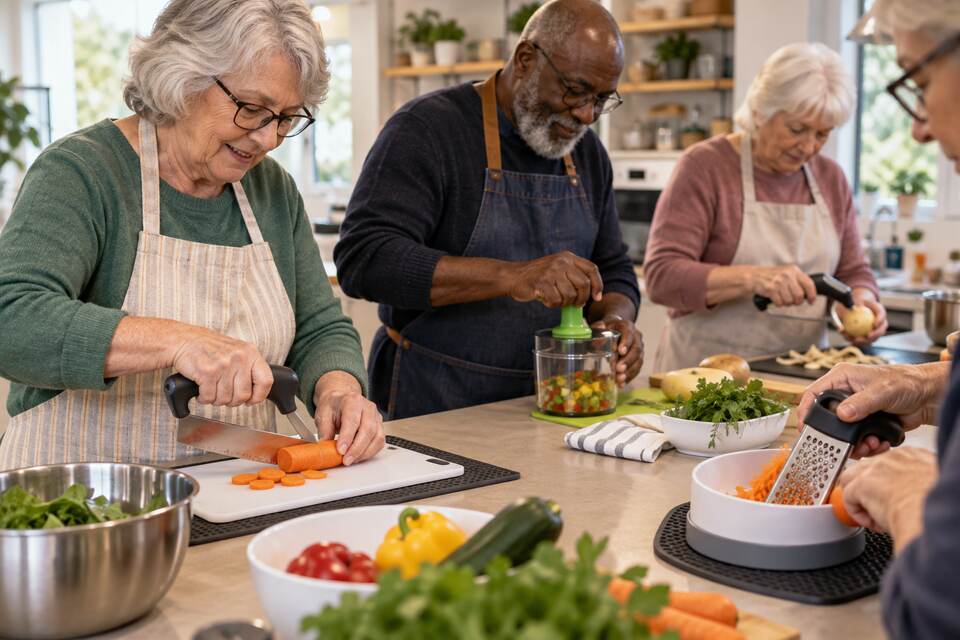
The Silver Wellbeing workshop was designed to help older adults participate in cooking on their own terms. It begins with reflection: what cooking has meant across their lives. For some, it has been a lifelong role; for others, a new experience. Research shows that perceived usability of the home is shaped not only by physical ability but by confidence and self-perception.
Adaptive Cooking Practice
Participants are introduced to wide-grip utensils, stabilising rings, non-slip mats, gentle-heat methods, and mobility-friendly steps. Each recipe includes alternatives: “If this step is difficult, try this instead.” These adjustments are self-advocacy tools, not shortcuts. Studies show that adapted cooking reduces anxiety and increases engagement.
Agency and Supported Participation
Agency Cards provide prompts such as “Pause if you need — you’re still in control.” These cues reinforce supported participation rather than replacement, aligning with research showing that older adults thrive when agency is preserved.
Sensory and Cultural Engagement
Smell-evoked memories are older, more vivid, and more emotionally positive. Familiar flavours and cultural steps help participants reconnect with memory, belonging, and joy.
The Silver Wellbeing workshop is not a cooking class. It is ageing-well in practice — restoring confidence, strengthening identity, and proving that participation is still possible, simply in a different way.
About the Author
Siew is an ageing-well practitioner and founder of Silver Wellbeing, a model that supports older adults to participate in cooking through adaptive techniques, sensory engagement, and agency-based practice. Her early work in Malaysia led to the development of the Silver Floss dyadic cooking model, which has since gained interest and growing research support. She continues to refine and expand the model in Australia, presenting at ageing forums and demonstrating how readjustment — not decline — can restore confidence, identity, and joy in later life.
[…] ← Previous: When Cooking Becomes Difficult Next: Returning to the Kitchen — Inside the Silver Wellbeing Workshop → […]